
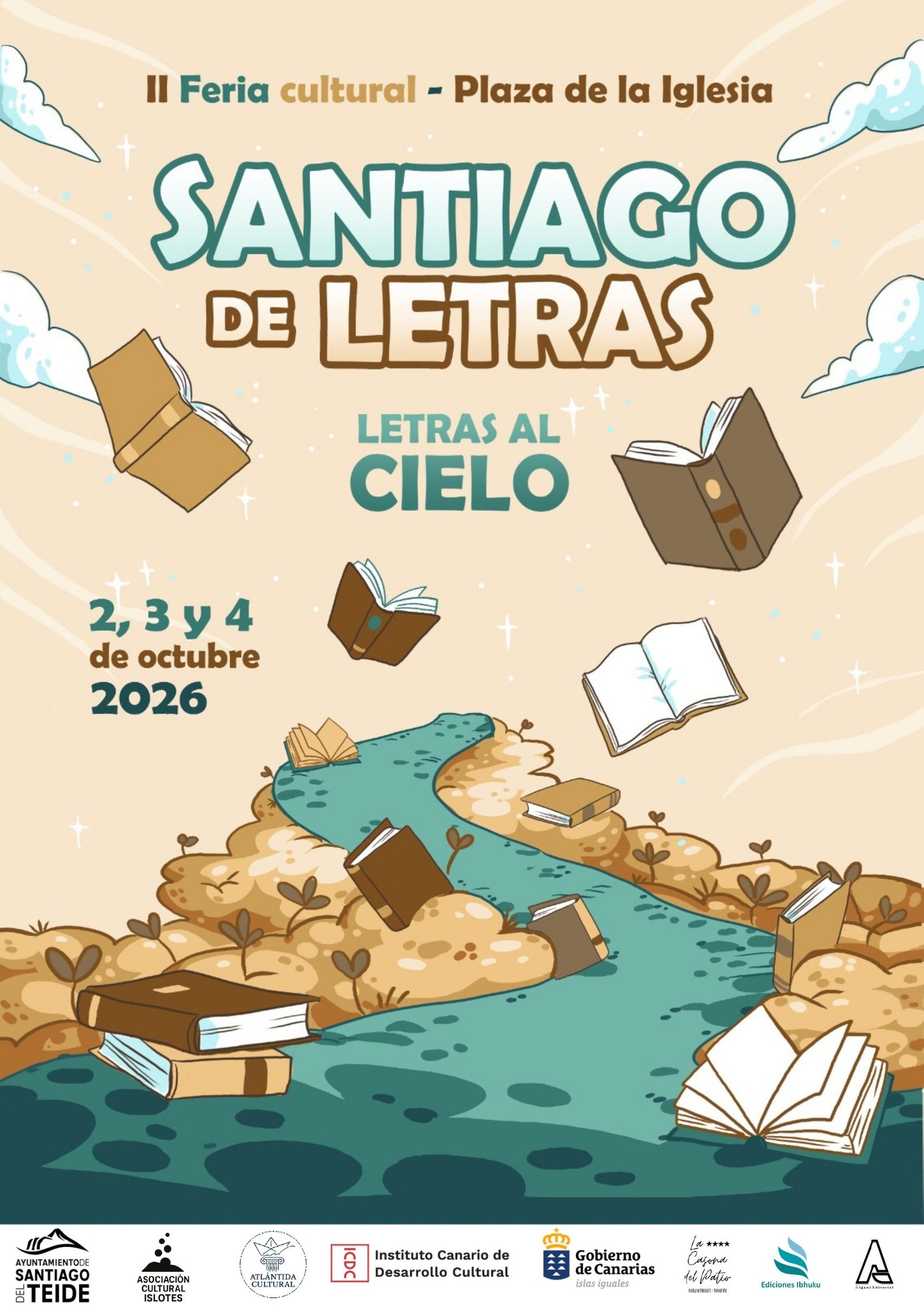
Santiago de Letras turns Santiago del Teide into a meeting ground for the Canary Islands, literature, and new readers
On October 3 and 4, the festival’s second edition will bring together national and Canarian authors for a program that champions culture outside major urban centers, strengthens cultural partnerships, and solidifies bridges built with other regions.
On October 3 and 4, Santiago del Teide will once again become a place where books do more than just get presented—they connect with people. The second edition of Santiago de Letras, themed "Letras al cielo" (Words to the Sky), will gather writers, readers, schoolchildren, families, bookstores, and cultural projects in the town square. The festival is growing with a clear vision: to demonstrate that literature can inhabit public spaces, foster community, and build bridges from this southern Tenerife municipality to other places.
Following an inaugural edition that launched the project and opened new avenues for collaboration with other regions, Santiago de Letras returns with a program that deepens this commitment to exchange. The partnerships and bonds forged around the festival aim to connect communities through authors, activities, and shared experiences, turning literature into a genuine meeting place.
One of the most visible examples will be *Contar lo nuestro* ("Telling Our Story"), an educational project that took fourth-grade students from Santiago del Teide on a journey to Miño, Galicia, to write and share their own stories. Now, they will take the festival stage to read their texts and share what it meant to write, travel, and discover that their stories could cross the Atlantic.
Renowned figures and Canarian voices sharing the same stage
This year, Santiago de Letras will bring together guests from outside the islands alongside a significant lineup of Canarian authors and creators. The roster for this second edition includes Alfredo Relaño, May R. Ayamonte, and Pedro Martí, as well as authors such as Ceci Wallace, Diego G. Reinfeld, Marcos Dosantos, Antonio Martín Piñero, Sophia Hidalgo, Ana Nayra Gorrín, Jesús Barranco, Iván Cabrera Cartaya, and Montse Díaz, among other participants. The interaction among authors with diverse backgrounds and career paths is a hallmark of the festival: bringing established voices, fresh perspectives, and literature from the Canary Islands together on the same stage, while fostering ongoing dialogue among authors, readers, booksellers, and the public. On Sunday, this perspective will take center stage in "Writing from the Periphery" (*Escribir desde la periferia*), a conversation featuring Ana Nayra Gorrín, Jesús Barranco, Iván Cabrera Cartaya, and Montse Díaz—moderated by Pablo Canino—to discuss territory, the creative process, and what it means to write and build a literary career from the islands.
Sunday’s program will also feature Alfredo Relaño, one of the most recognizable figures in Spanish sports journalism, who will discuss journalism, sports, memory, and books with María Romero Medinilla. On Saturday, May R. Ayamonte and Pedro Martí will share the stage for one of the festival's key events, part of a day packed with presentations, workshops, and conversations running from morning through the evening.
Reading, writing, listening, creating
The Santiago de Letras initiative deliberately steers clear of a festival built solely around a succession of book presentations. Its program invites the public to actively engage with literature.
Events include a Literary Breakfast for intimate conversations with female writers; a haiku workshop led by Iago Fandiño; comic book character creation with Fran Rodríguez Vié (of *La Visión de Fran*); children's literature sessions with Diego G. Reinfeld; plus author meet-and-greets, book signings, a book fair, and areas dedicated to discovering new reads.
Also featured is *Poesía para todas las tallas* ("Poetry for All Sizes"), a concept that turns a clothing rack into a literary space, inviting people to choose poems much like picking out a garment that fits just right. Saturday will conclude with music by Sandra Santana, extending the festival’s vision of literature as part of a broader cultural experience.
A public square for creating readers
Children and young people take center stage. Santiago de Letras is founded on the idea that fostering a love of reading isn't just about putting books within children's reach; it’s about allowing them to experience culture as something that belongs to them, too. That is why the program includes storytelling, workshops, reading corners, and creative activities, alongside experiences like *Contar lo nuestro* ("Telling Our Stories"), where children step out of the role of spectator to become authors and protagonists themselves. For two days, the town square is transformed: bookstores move outdoors, writers chat informally with their readers, children write and create, poems appear among the clothing racks, and books mingle with music, the landscape, and the municipality's daily life.
"Santiago de Letras was born from the idea that culture doesn't always have to take place in the same old venues. We want Santiago del Teide to be a destination for a weekend where people come to connect with books—but above all, with each other. We want our local authors to share space with visiting writers, for children to discover that their own stories deserve to be told, and for the bonds we build with other regions to keep growing." "A festival makes sense when what happens there remains alive after the tents are taken down," notes Emilia Vié, director of Santiago de Letras.
From Santiago to Santiago
The municipality's very name offers the project a thread that Santiago de Letras has sought to turn into a path. The link with Miño and the EnCaMiño festival is part of a commitment to connect territories through culture and the shared imagery of the Camino de Santiago (Way of St. James). In its second edition, this path is beginning to show tangible results: relationships between creators, educational experiences, travel, and joint projects. It is not just about bringing culture to Santiago del Teide, but also about enabling what originates in Santiago del Teide to travel elsewhere.
Support for a cultural project rooted in the local area
The consolidation of this second edition is further supported by the Canary Islands Institute of Cultural Development (ICDC) and the Government of the Canary Islands. They have joined a project committed to the decentralization of culture, literary creation, and fostering encounters between authors and readers, all based in Santiago del Teide.
On October 3 and 4, that journey begins anew at the Church Square (Plaza de la Iglesia). On Saturday, the official opening ceremony will take place at 10:45 a.m., with the program continuing throughout the day. On Sunday morning, the festival will once again open the square to literature. Admission to the festival is free. Some activities have limited capacity and require prior registration.
The full program, schedules, and activity details can be found at www.santiagodeletras.com.
Santiago de Letras 2026 is organized by the Santiago del Teide City Council, the Islotes Cultural Association, and Atlántida Cultural, with the support of the Canary Islands Institute of Cultural Development (ICDC) and the Government of the Canary Islands.
Media Availability
Authors and participants of Santiago de Letras 2026 will be available for interviews and meetings with the media, both during the festival and—where possible—in the days leading up to it. The festival’s management and organizing team are also available for interviews, additional information, content coordination, and any other needs related to coverage of Santiago de Letras. Interested media outlets may contact the organizers to arrange author interviews, request visual materials, or obtain further details about the festival and its activities.
Press and Organization Contact
Emilia Vié · Santiago de Letras Management
Tel. 662 955 596

